Mention the word hero if you're active-duty military, a veteran, or a first responder
Thermal Imaging Inspections
Thermal Imaging Inspections in the Greater Houston Area
Thermal imaging can provide valuable information that may not be apparent during a conventional visual inspection. Using an infrared camera, Frontline Inspections, PLLC can identify temperature differences across accessible surfaces that may warrant further investigation.
Thermal imaging is an enhanced inspection service and is not required by the Texas Real Estate Commission (TREC) Standards of Practice. The current TREC SOP specifically identifies thermal imaging equipment as specialized equipment that is not required to satisfy the minimum inspection requirements. However, TREC permits inspectors to provide a higher level of inspection performance and use specialized equipment when the inspector is competent to do so.
What Is Thermal Imaging?
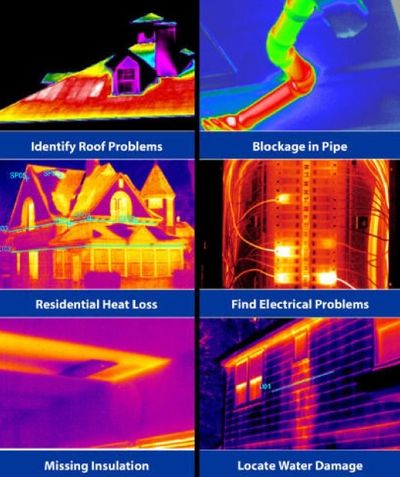
Thermal imaging uses an infrared camera to detect and display differences in surface temperature. Unlike a conventional camera, a thermal imaging camera does not simply photograph what is visible to the eye. It detects infrared energy emitted from surfaces and translates temperature differences into a visual thermal image.
These temperature differences can sometimes provide indications of conditions that deserve additional investigation.
Thermal imaging may be particularly useful when evaluating:
- Electrical components
- HVAC systems
- Plumbing systems
- Ceilings and walls
- Windows and doors
- Insulation
- Attic areas
- Moisture-related conditions
- Accessible roof areas
- Other accessible building components
What Thermal Imaging Can Help Identify
Thermal imaging may reveal temperature patterns associated with conditions such as:
Electrical
Thermal imaging may identify unusual heat patterns at accessible electrical components, including:
- Electrical panels
- Circuit breakers
- Disconnects
- Conductors and terminations
- Accessible electrical equipment
An unusual temperature pattern may indicate a condition requiring further evaluation. Thermal imaging alone, however, does not establish the cause of an elevated temperature or determine whether an electrical component is safe.
HVAC Systems
Thermal imaging can be used as an additional diagnostic tool when evaluating HVAC performance.
Temperature patterns may help identify:
- Supply-air temperature differences
- Uneven cooling or heating
- Possible duct leakage
- Areas of missing or inadequate insulation
- Possible airflow concerns
- Temperature anomalies around HVAC components
Thermal imaging does not replace HVAC testing or evaluation by a qualified HVAC professional.
Plumbing and Moisture-Related Conditions
Temperature differences may sometimes reveal patterns associated with water movement, plumbing conditions, or areas of suspected moisture.
Thermal imaging may help identify:
- Temperature patterns around plumbing
- Potentially cooler or warmer areas associated with water
- Possible areas of moisture-related concern
- Areas warranting additional investigation
A thermal image does not prove the presence of moisture or a leak. Temperature differences can result from many causes. Where appropriate, additional evaluation using moisture meters, visual inspection, or other diagnostic methods may be recommended.
Insulation and Building Envelope
Thermal imaging can sometimes identify temperature variations associated with:
- Missing insulation
- Displaced insulation
- Thermal bridging
- Air leakage
- Temperature differences around windows and doors
- Areas of suspected building-envelope deficiencies
Thermal imaging observations should be interpreted in conjunction with the physical characteristics and conditions of the building.
Attic and Roof Areas
When conditions are appropriate, thermal imaging may be used to supplement visual observations in accessible attic or roof areas.
Thermal patterns may identify areas that warrant additional investigation for possible:
- Moisture-related conditions
- Insulation deficiencies
- Air leakage
- Temperature anomalies
Thermal imaging is not a roof leak detection guarantee and cannot determine the source of water intrusion by itself.
Thermal Imaging Is an Additional Inspection Tool
Thermal imaging supplements the visual inspection; it does not replace it. The current TREC Standards of Practice define a real estate inspection as a limited visual survey and basic performance evaluation and specifically state that the inspection is not intended to be a comprehensive investigation or exploratory probe to determine the cause or effect of deficiencies. TREC also states that thermal imaging equipment is not required as part of the minimum inspection.
When thermal imaging is used, Frontline Inspections considers thermal images together with:
- Visual observations
- System operation
- Building conditions
- Ambient conditions
- Temperature differences
- Other available inspection information
An abnormal thermal pattern may be documented as an indication requiring further evaluation, rather than being represented as a confirmed defect when the thermal image alone cannot establish the cause
.
Important Thermal Imaging Limitations
Thermal imaging has significant limitations and should not be interpreted as an X-ray or a means of seeing through walls or other materials.
Thermal imaging generally detects surface temperature patterns, not hidden objects or conditions directly.
Thermal images can be affected by:
- Ambient temperature
- Weather conditions
- Sunlight and solar loading
- Wind
- Humidity
- Building materials
- Surface finishes
- Emissivity
- Reflected infrared energy
- HVAC operation
- Recent system operation
- Insulation
- Air movement
- Moisture
- Distance from the target
- Viewing angle
Consequently, an abnormal thermal pattern does not necessarily indicate a defect, and a normal thermal image does not guarantee that no defect or concealed condition exists.
Thermal Imaging and Moisture
Thermal imaging can sometimes help identify temperature patterns that may be associated with moisture, but thermal imaging is not moisture testing.
A thermal camera does not directly measure moisture content. Where a thermal anomaly suggests a possible moisture-related condition, additional investigation may be recommended.
This may include evaluation with an appropriate moisture meter or further investigation by a qualified contractor or specialist.
Thermal Imaging and Electrical Systems
Thermal imaging can identify temperature differences at accessible electrical components, but it is not a substitute for electrical testing.
A thermal anomaly may be influenced by electrical load, ambient temperature, connections, equipment design, or other factors.
Where an abnormal thermal pattern is identified, further evaluation by a qualified electrical professional may be recommended.
Reporting
When thermal imaging is included in the inspection, significant or potentially significant thermal anomalies may be documented in the inspection report.
The report may include:
- A conventional photograph
- A corresponding thermal image
- The location of the observed condition
- A description of the thermal pattern
- Relevant inspection observations
- A recommendation for additional evaluation when appropriate
Thermal images are interpreted in the context of the overall inspection and are not independently treated as proof of a defect.
Professional Thermal Imaging Inspections
At Frontline Inspections, PLLC, thermal imaging is used as an additional diagnostic tool to enhance the visual inspection and help identify conditions that may otherwise warrant further investigation.
Our goal is not simply to produce thermal images, but to interpret observable temperature patterns in conjunction with the home's systems, components, and physical conditions.
Serving the Greater Houston Area
Call or text 281-640-0101 to schedule your inspection or request a free inspection quote.